
Decontamination.ai 139 | Hyperbaric Oxygen Therapy HBOT Chamber Review for Medical Clinic
This is a critical science, technology & engineering review of HBOT chambers for a medical clinic that has agreed to utilize reactwell.com's buy services to verify equipment before purchase.

I’ve been tasked to review a new Hyperbaric Oxygen Chamber for Hyperbaric Oxygen Therapy HBOT for a Medical Clinic as part of reactwell.com’s buyer services. This publication reviews HBOT chambers from a science, technology and engineering perspective and has insights into chemical safety as well as fire safety as I’ve held various roles.
Disclaimer: This is NOT professional advice or services. If you require buyer services for your medical clinic or hospital or offices or wellness center, you can contract directly with me by going to www.reactwell.com to assist. My clients for buyer services include some of the largest multi-national corporations in the world as listed at https://www.reactwell.com
Basics of HBOT, a person gets into the chamber at atmospheric pressure, with atmospheric oxygen line running to an oxygen mask then the chamber door is closed and sealed and then the pressurization sequence begins, it runs for about 60 minutes and then the chamber goes through a depressurization sequence back to atmospheric then the safety-interlocks on the chamber’s door are disengaged and the door is able to be opened or automatically opens for the client, person or patient inside of the chamber.
HBOT chambers are designed to either lay down in (longer cylindrical chambers) or to work and sit-in. If you are buying your first HBOT chamber you want a laydown chamber as the bloodflow to the brain is enhanced due to assistance from gravity, not working against gravity, but neutralizing it to an extent in the horizontal x-axis. The worst mistake one can make is to buy a sit-in sit-up HBOT chamber that the body has to work against gravity to flow and push oxygen through and into the brain, that’s rule number one for a medical clinic, go with horizontal laydown chamber orientation.
Presssure, HBOT chambers have been tested by the world’s militaries up to 5.0 atm to be safe, above that weird stuff happens inside of the body that is NOT good for human health, wellness and performance.
I recommend a good starting pressure chamber at 2.0 to 3.0 atm depending upon budget. The lower pressure 1.5 atm chambers are only useful for wellness centers that don’t have a medical doctor or professional on staff and the liability is the issue (insurance is the driver on the purchase decision). Personal units should all be at a minimum of 2.0 atm.
What is 2.0 atm and how does it feel? If you go jump into the ocean and swim down to 32 feet (adjust for salinity of the given body of water) then you’ll be at 2 atm and that’s how the chamber will feel when inside of it. When diving, anything below 50 feet or so requires special depressurization protocols, so the 32 feet depth per common sense diving benz rules is safe, less the oxygen fire triangle combustion NFPA considerations.
So, back to basics, the first chamber a medical clinic or office or hospital should consider if they’re getting rid of an older low pressure unit or looking to purchase their first should be a 2.0 atm to 3.0 atm unit with the 2.0 atm units being the most economically accessible.
Next-up is the oxygen supply, you need to get an oxygen concentrator system that can flow at least 10 litres per unit to keep up with the chamber pressurization step. I do not recommend any large storage tanks or surge tanks for the use case of a clinic as that adds risk. Then there is the oxygen compressor unit that takes the oxygen from the concentrator and brings it up to pressure to enter the HBOT chamber when at design working pressure 2.0 atm) for example (e.g. twice atmospheric pressure of the local environment).
You should have a dedicated room for the oxygen chamber that has no natural gas fire places or electric cooktops or other natural gas or electric fire sources. The room should be dedicated to the HBOT chamber with proper sensors in place in case there is a leak or other items of concern regarding fire triangle combustion.
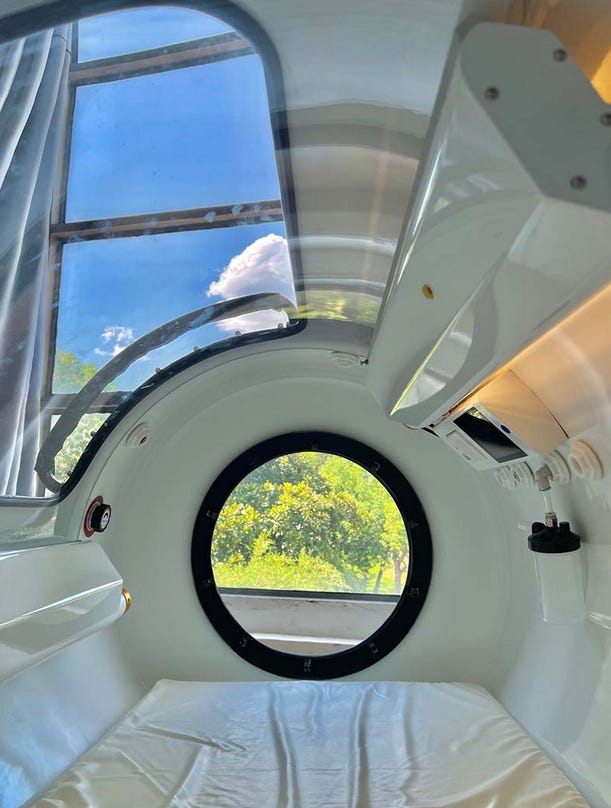
I recommend a chamber that has NO electronics on the inside of it to minimize risk, people will ask for screens, etc. but for the first chamber that’s a NO-GO. Keep it simple and safe.
There are some manufacturers that sell “hard” or “soft” HBOT chambers … that’s not relevant here as 2.0 atm and above are all “hard” chambers
DO NOT cheap out on the compressor or oxygen concentrator units from a cap-x perspective, those two pieces of equipment are just as important as the actual HBOT chamber. Also, maintenance schedule is required for these types of units, especially for any audit requirements, above and beyond common sense maintenance for a pressurized oxygen system.
